
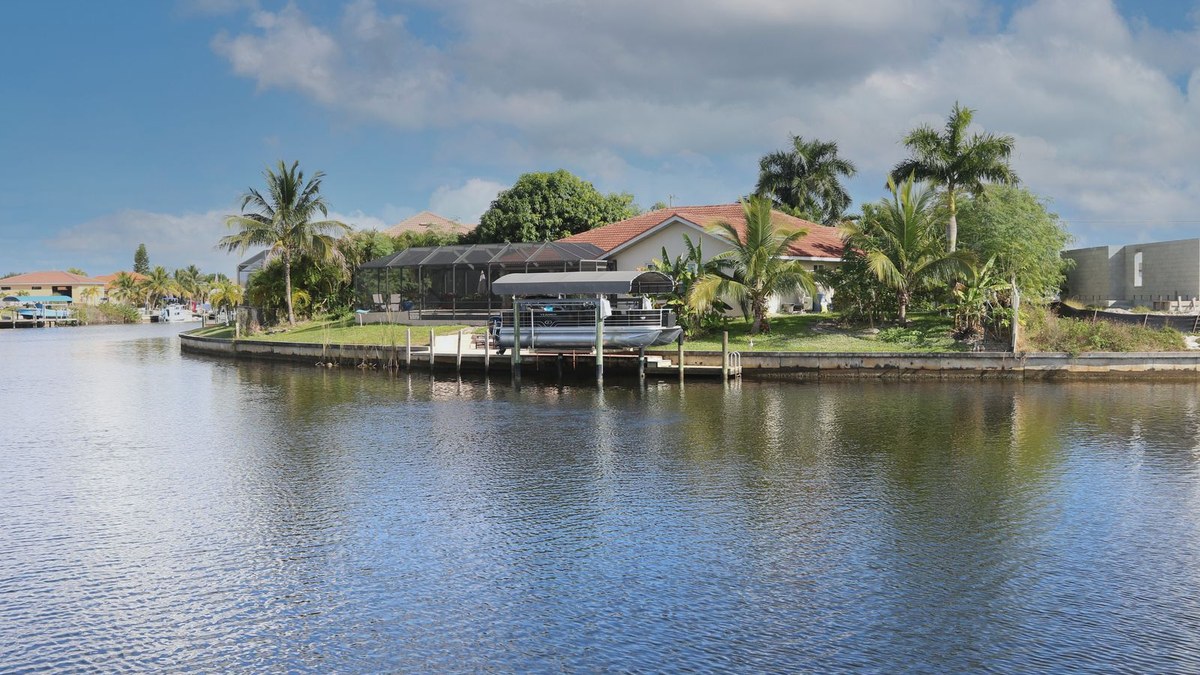
Building on a Cape Coral Gulf-Access Lot: What Changes About Your Foundation, Insurance, and Timeline
A gulf-access lot is the dream for a lot of families moving to Cape Coral. You walk out the back door, step onto your dock, and you are in open water without ever loading a trailer. It is one of the best things about building here.
It is also the version of a new build with the most moving parts. The house you put on a canal lot is not the same house you would put on a dry lot three streets inland — not structurally, not on the insurance side, and not on the calendar. None of that is a reason to walk away. It is a reason to know what you are signing up for before you pick a floor plan.
Here is what actually changes.
Your foundation may sit higher — and that is a good thing
Every lot in Lee County sits in a flood zone, and canal lots typically sit in one of the higher-risk zones with a higher base flood elevation. Base flood elevation is simply the height floodwater is expected to reach in a major event. Your finished floor has to be built above it.
On a dry inland lot, that is often no drama at all — a standard monolithic slab poured close to grade already clears the requirement. On a gulf-access lot, it frequently means bringing in fill to raise the building pad, or building on a stem wall so the finished floor sits well above the surrounding grade.
What that means for you in practical terms:
- More site work up front. Fill, compaction, and compaction testing happen before anything vertical starts.
- A few steps up to the front door, and a driveway and walkways designed to meet the new elevation cleanly.
- An elevation certificate once the slab is in — a surveyor documents exactly how high your finished floor sits. Keep that document. It is what your insurance agent will ask for first.
The higher you build above that base flood elevation, the better your position for the rest of the home's life. It is one of the few places where money spent early keeps paying you back every single year.
Your seawall and dock are their own project
The house and the waterfront are two different scopes of work, and it helps to think of them that way from day one.
If the lot already has a seawall, get it looked at before you close. Cap condition, tie-back condition, and any sinkholes or soft spots in the yard behind the wall all tell you something. If the lot needs a new seawall, that is separate permitting and separate scheduling — and it is far easier to do before the house goes up than after your landscaping is in.
Docks, lifts, and captain's walks are permitted separately as well, usually through the city and sometimes with additional agency review depending on the waterway. Boat lift capacity is worth deciding early, because the boat people buy two years after moving in is rarely the boat they described when they bought the lot.
Your insurance conversation starts sooner
Homeowners in Southwest Florida carry two related but separate coverages: a wind and hazard policy, and flood coverage. On a canal lot, flood is the one that deserves your attention early.
Flood pricing keys off elevation. Where the finished floor sits relative to base flood elevation is the number that matters, and that number is set the day the slab is poured — not the day you close. Talk to an insurance agent while you are still finalizing plans, not after.
The good news on the wind side: a home built to today's Florida Building Code is a genuinely different structure than one built twenty years ago. Reinforced masonry walls, engineered roof-to-wall connections, and impact-rated windows and doors are standard on a new build, not upgrades you have to fight for. Ask for the wind mitigation form when the house is complete. It is the document that earns you credits, and a new home tends to check nearly every box on it.
Your timeline has a longer front end
The build phase — slab to keys — runs about the same on a canal lot as anywhere else. What stretches is everything before the slab.
Expect additional survey work, more engineering on the pad and foundation, sometimes an additional agency review because of the waterway, and fill delivery and compaction that has to be documented before inspection. On a dry lot, site work can be a couple of weeks. On a canal lot, plan for meaningfully more.
That front end is exactly where a builder either keeps you informed or leaves you guessing. Our process is built around the second half of that sentence never happening: a schedule you can see, a single point of contact, and updates through Buildertrend so you always know what happened this week and what is happening next.
What to ask before you buy the lot
If you have a gulf-access lot under contract or you are looking at a few, get answers to these before you sign anything:
- What flood zone is it in, and what is the base flood elevation?
- Is city water and sewer already at the lot, or is this an assessment area?
- Is there an existing seawall, and what condition is the cap and the tie-back system in?
- Is it true gulf access, or is there a bridge between this canal and open water? Bridge height determines what you can actually run out of your backyard.
- What is the setback from the seawall, and how much buildable width does that leave you?
That last one catches people. A wide-looking lot with a deep required setback can quietly rule out the floor plan you fell in love with. Better to find that out now.
Build it once, build it right
A gulf-access build has more steps than a standard lot. It also produces a home that is elevated correctly, built to current code, documented properly for insurance, and sitting on water — which is why you moved here in the first place.
We build on our lots and on yours, we are licensed and insured, and every home we deliver is backed by our standard builder warranty. If you have a canal lot in hand or you are still shopping, we will walk it with you and tell you honestly what it will take.
Browse the floor plans, see what is available right now, or reach out to the team at 239-224-0371. We would love to help you get it right the first time.


