
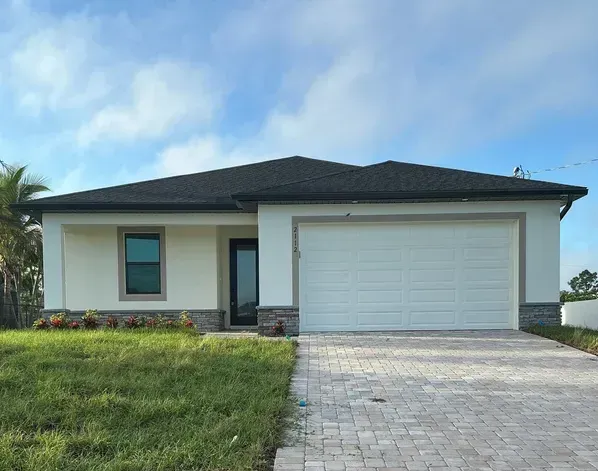
Energy Bills in a Brand-New Florida Home: What Owners Really Pay vs. a 20-Year-Old Resale
Ask a Cape Coral homebuyer what they budget for electricity and you'll usually get a shrug and a guess. Ask a homeowner who just moved out of a 2005 house and into a new build, and you'll get a much more specific answer — because they watched the number change on their own bill.
Energy cost is one of the few parts of homeownership you can actually estimate before you sign anything. So let's put real numbers on it: what a brand-new Southwest Florida home costs to run each month, what a 20-year-old resale in the same neighborhood costs, and where the gap actually comes from.
The starting point: what electricity costs here
Florida's average residential electricity rate sits around 15.4¢ per kilowatt-hour as of mid-2026 — roughly 14% below the national average. Locally, Lee County Electric Cooperative (LCEC), which serves Cape Coral and North Fort Myers, prices residential energy near 12.7¢ per kWh with a monthly base charge around $20, before the power cost adjustment that moves month to month.
The average Florida household uses about 1,247 kWh a month. Run that through LCEC's numbers and you land right around $178 a month, or roughly $2,100 a year. That's your baseline — the "typical Florida house" figure both new and older homes get measured against.
One more piece of context that explains everything below: 96% of Florida households run air conditioning, 90% of them with a central system, and electricity accounts for 94% of household energy use in this state. We don't argue about heating bills here. Cooling is the bill.
Where a 2006 home and a 2026 home part ways
A well-kept 2006 Cape Coral home is a perfectly good house. It was simply built to a 2004-era code, with the equipment and materials that were standard then. Two decades of code cycles have changed what "standard" means:
- Air conditioning efficiency. A central system installed in the mid-2000s was typically a 10–12 SEER unit. Federal minimums for our region now require 14.3 SEER2 for most split systems — and SEER2 is measured under tougher test conditions than the old SEER scale, so the real-world gap is wider than the numbers suggest.
- The building envelope. Today's code brings tighter air sealing, better duct sealing, upgraded attic insulation, and low-E windows as a matter of course. In a climate where the attic hits 130°F on an August afternoon, that envelope is doing more work than the thermostat is.
- Ductwork age. Ducts in an unconditioned attic leak more as they age. A 20-year-old duct run can lose a meaningful share of the cool air it's paid to move — air you're buying and dumping into the attic.
- Water heating and appliances. Second only to cooling on most Florida bills, and both have improved substantially in twenty years.
The number the industry actually uses
There's a standardized score for this: the HERS Index, from RESNET. A new home built to code scores 100. A typical U.S. resale home less than 20 years old averages about 130 — meaning roughly 30% less energy efficient than the reference home.
Be careful how you read that, though. The HERS Index covers the loads a builder controls — heating, cooling, water heating, lighting, fixed appliances. It doesn't score your pool pump, your second refrigerator in the garage, or how cold you like the bedroom at night. So a 30-point HERS gap does not mean your bill drops 30%.
Here's the honest translation. Cooling and water heating together make up roughly 60–65% of a Southwest Florida electric bill. Apply a 25–30% efficiency improvement to that portion and you get about a 15–20% reduction in the total bill. Industry estimates for energy-efficient Florida homes tend to land in that same 20–30% range on utilities, so the math is consistent from both directions.
What that looks like in dollars
Using the local baseline of about $178 a month for a typical Florida household:
| 20-year-old resale | New construction | |
|---|---|---|
| Typical monthly bill | ~$178 | ~$142–$151 |
| Typical annual cost | ~$2,136 | ~$1,704–$1,812 |
| Annual difference | ~$320–$430 | |
| Over 10 years | ~$3,200–$4,300 | |
Call it $25 to $35 a month. That's the realistic, defensible range — not the headline number some marketing loves to quote, but the one that holds up when you compare actual bills.
And notice what that table leaves out. It doesn't count the AC replacement a 20-year-old system is due for, or the water heater, or the re-insulation. Those are separate line items, and they arrive on their own schedule.
Three things that move the number more than the house does
Before you budget anything, know that a few of your own choices swing the bill harder than construction year:
- Thermostat setpoint. Every degree cooler you hold the house costs real money over a Florida summer. Two households in identical homes can be $40 a month apart on this alone.
- Pool equipment. A pool pump can be one of the largest single loads in the house. A variable-speed pump on a sensible schedule changes the picture significantly.
- Square footage and orientation. A larger home costs more to cool, and west-facing glass in Southwest Florida earns its afternoon reputation. Both are worth thinking about at the floor-plan stage — when they're still free to change.
How to check this for yourself
You don't have to take anyone's word for it, ours included. Two requests will tell you most of what you need to know:
On a resale you're considering: ask the seller for 12 months of electric bills, and ask the age of the AC system and water heater. Twelve months matters — a January bill tells you nothing about August. If the numbers aren't available, that's information too.
On a new build: ask the builder for the AC system's efficiency rating, the window specifications, and the attic insulation R-value in writing. Any builder who manages their process well can hand those to you without hunting.
Then compare like for like: annual cost per square foot, not monthly totals on two different-sized houses.
The part that gets forgotten
Energy efficiency is a nice line on a spreadsheet. Predictability is what people actually value once they're living in the home.
In a new build, the major systems are new, they're under warranty, and the bill you see in month three is close to the bill you'll see in year three. In an older home, the utility cost is the smaller of the two conversations — the bigger one is which system reaches the end of its life first. That's not a knock on resale homes. It's just a different set of numbers to plan around, and worth planning around honestly.
Building in Cape Coral and Southwest Florida
At Douglas Brooke Homes, we build on schedule and on budget, on your lot or ours, with six thoughtfully designed floor plans and the standard builder warranties behind them. If you'd like the specifications for a plan you're considering — including the efficiency details above — we're glad to walk through them with you.
- Browse our floor plans and models
- See what's available now
- Review our warranty coverage
- Investors building a rental portfolio: start here
Questions about a specific plan or lot? Get in touch or call us at 239-224-0371. We'd love to help you find the right home for your family.
Rate and consumption figures reflect published Florida and LCEC residential averages as of July 2026 and are used for illustration. Your actual bill depends on your home, your equipment, and how you use it.


